

ENI Observatory is a permanent campaign by A Sud and CDCA to monitor Eni’s activities. Through research, reporting, and shareholder activism, we work to expose Eni’s impacts on the environment, the climate, and human rights. We engage in public advocacy and lobbying to push Eni to change its corporate policies.
What does ENI Observatory work on?
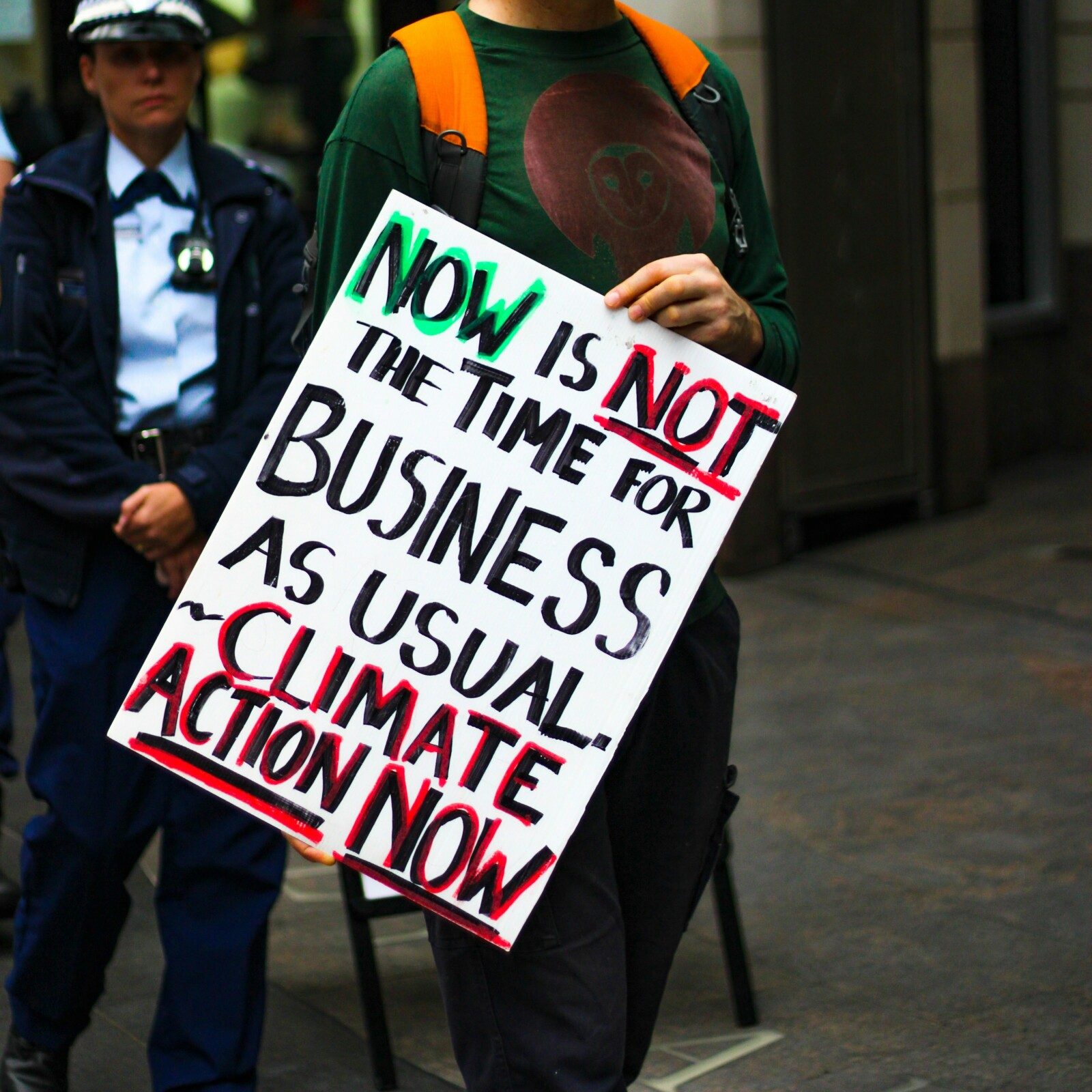
CLIMATE RESPONSIBILITIES
Eni’s core business is the extraction of hydrocarbons: oil and gas. Its direct emissions amount to tens of millions of tonnes of CO₂; if we include indirect emissions generated by the use of its products, this rises to hundreds of millions of tonnes — more than the total emissions of Italy.
This is not an exception, it is a model. According to the Carbon Majors Database, 80% of global fossil emissions since 2016 can be attributed to just 57 companies. Among the 122 main contributors, the majority have increased production. Eni is part of this ranking: 33rd in the world, 9th among private companies for greenhouse gas emissions since 2016.
Energy Transition: Words vs. Reality
Despite its rhetoric around the energy transition and investments in renewables, Eni continues to rely on fossil fuels, significantly contributing to greenhouse gas emissions. Much of its operations are concentrated in countries of the Global South, where extraction has severe impacts on territories, ecosystems, and the rights of local communities.
This reality is matched by a dangerously softened corporate narrative. It is no coincidence that Eni’s marketing is becoming increasingly green. The six-legged dog presents itself as a responsible actor and an ally of the transition, while drilling continues to extract oil and gas. This gap between what is said and what actually happens has a precise name: greenwashing.
NATIONAL ENERGY POLICIES
Although it operates as a publicly listed multinational energy company, Eni is partly state-owned, with the State holding a controlling share. Instead of being guided by national decarbonisation policies, Eni influences national energy policies.
This creates a vicious cycle that is difficult to break. Despite the climate crisis and repeated warnings from the scientific community, the company continues to increase the amount of hydrocarbons it extracts year after year. It is developing new drilling projects to exploit hydrocarbons both abroad and in Italy. From Val d’Agri in Basilicata to Taranto and Gela in Sicily, several areas are suffering the devastating impacts of the six-legged dog.
ENERGY COLONIALISM
The outbreak of the war in Ukraine has made Eni’s influence on Italian energy policies even more evident. Behind the rhetoric of “transition”, the company has strengthened its fossil fuel strategy, inaugurating a new phase of energy colonialism: replacing Russian gas with supplies from authoritarian regimes such as Algeria and Qatar. No real transition — just crises used as an excuse.
This context also includes the Mattei Plan for Africa: presented as cooperation and development, but in reality opaque and neo-colonial. A project that reproduces extractivist logics, bending territories and communities to the energy interests of the West. It is not a plan for climate and social justice. It is a plan of power.

CULTURE
And speaking of greenwashing, Eni also invests in culture — not out of a love for the arts, but to build itself a mask. It uses its economic power to colonise the collective imagination, embedding itself in museums, festivals, and theatres.
Instead of supporting independent culture, it promotes a domesticated narrative that legitimises its role in the ecological transition. In this way, polluters become patrons, and culture turns into a showcase for fossil interests. The result is an increasingly complicit cultural landscape, emptied of conflict, critique, and truth.
(Photo by Carlotta Indiano)
TOOLS

Research and Information
We research, analyse, and publish articles across various outlets to expose Eni’s practices and its environmental and climate responsibilities.

Reporting and Dossiers
We produce, publish, and disseminate reports on different aspects of corporate activities (all available for download at the bottom of the page).

Shareholder Activism
We participate in Eni’s shareholders’ meetings as critical shareholders, submit questions to the Board of Directors on key issues, and facilitate the participation of local committees in Italy and abroad.

Advocacy and Lobbying
We carry out campaigns and advocacy actions to pressure the company to improve its policies.

Networking
We build alliances with local committees and national and international organizations working on environmental and climate justice, to collectively push for the decarbonisation of the economy.

Support for Affected Territories
We support local communities impacted by Eni, amplifying the voices of committees, activists, and residents affected by extractivism, and building tools for collective action and change.
Report
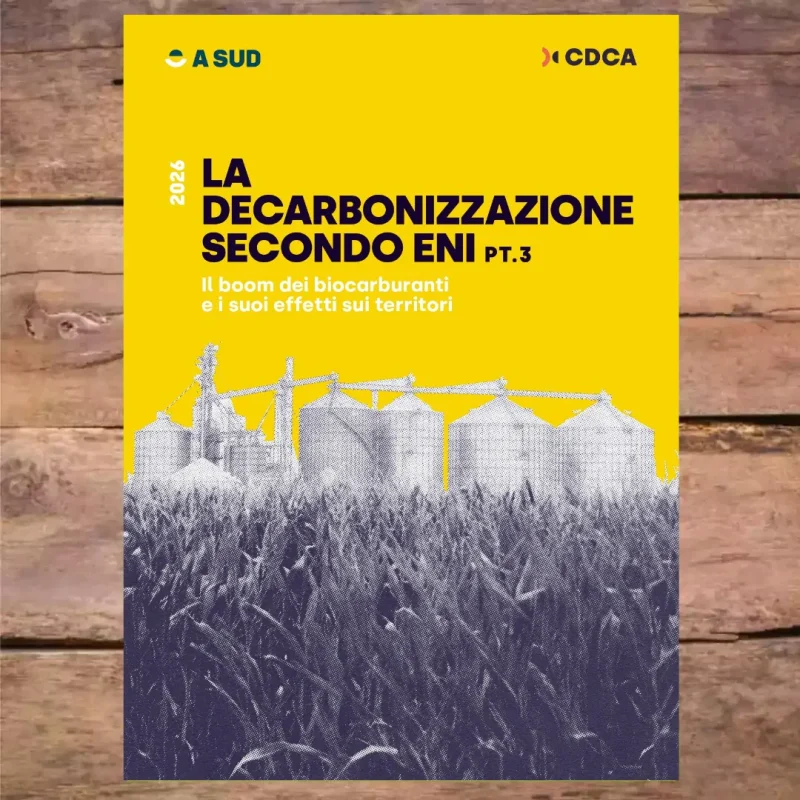
Decarbonisation according to ENI – The biofuels boom and its impacts on territories / 2026 (ITA)
In the 2026 Factsheet by ENI Observatory, we debunk the myth of biofuels: a false climate solution that shifts environmental and social costs onto territories. Not a response to the climate crisis, but yet another burden for communities and ecosystems.
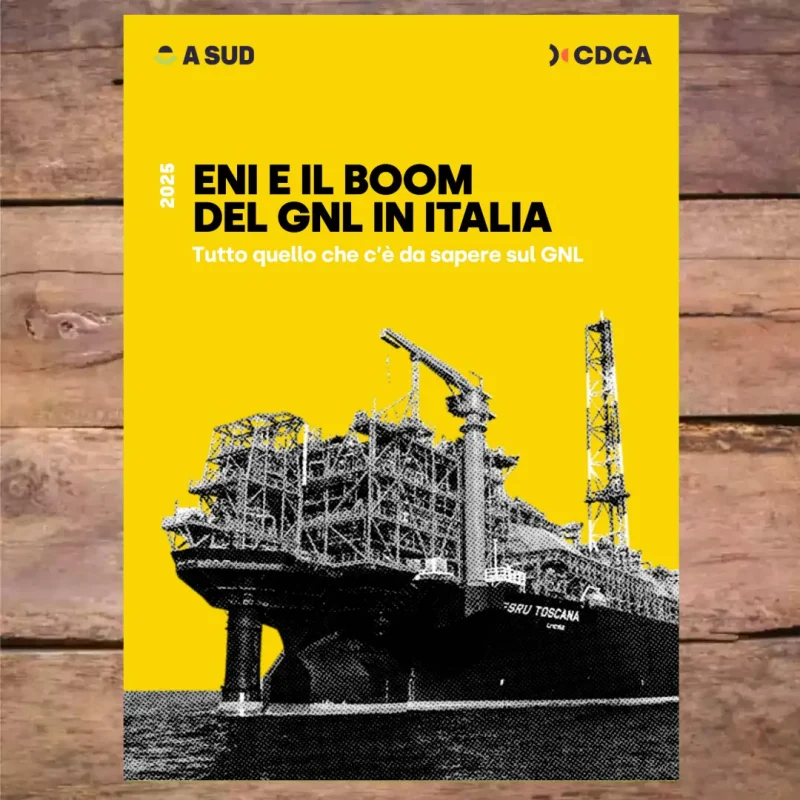
ENI and the LNG boom in Italy / 2026 (ITA)
Everything you need to know about LNG: Liquefied Natural Gas is promoted as a temporary solution to the energy crisis, but it is locking Italy into a new fossil dependency. This factsheet dismantles the “clean gas” narrative and reveals who is really profiting from the LNG boom.

Six-Legged Culture / 2024 (ITA)
How, where, and why Eni funds culture in Italy. This report explores the relationship between Eni and the cultural sector, showing how the oil giant presents itself as a promoter of numerous cultural initiatives. Through a critical analysis, “Six-Legged Culture” examines the company’s strategies of cultural washing.
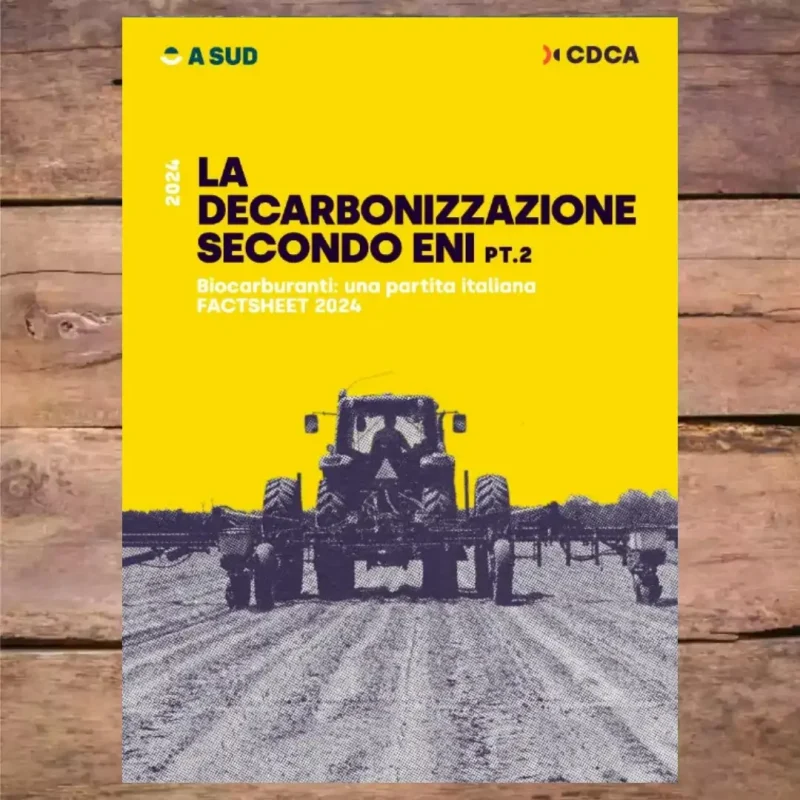
ENI’s Decarbonisation – Biofuels, an Italian case / 2024 (ITA)
A report analysing Eni’s biofuels strategy. These are presented as climate-neutral, but raise significant concerns in terms of efficiency and impact. Promoted as a renewable alternative to fossil fuels, they are derived from supposedly inexhaustible sources and aim to reduce greenhouse gas emissions. In Italy, Eni is actively pushing their expansion.
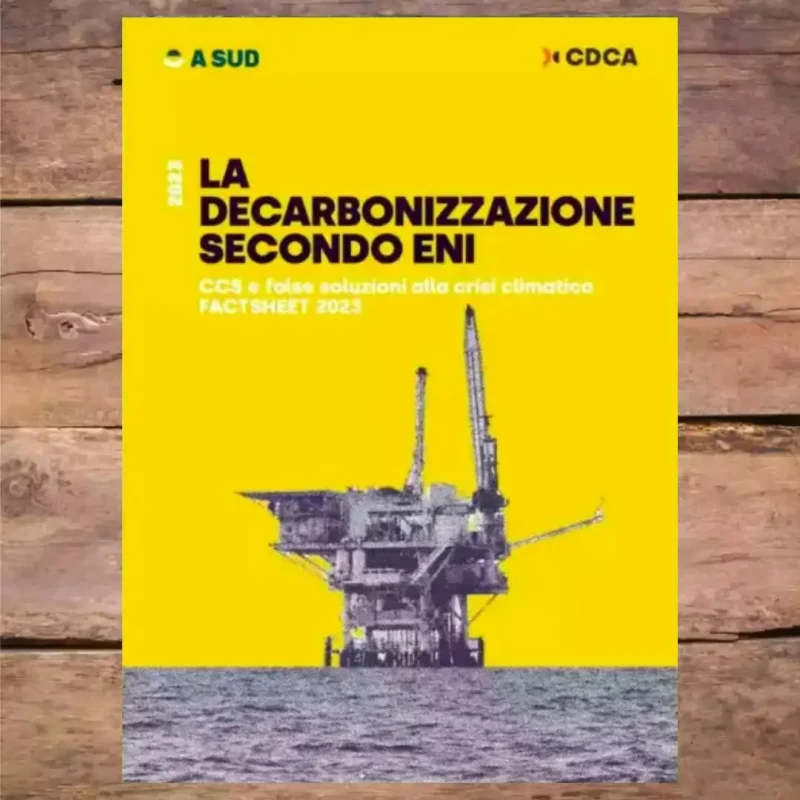
ENI’s Decarbonisation – CCS / 2023 (ITA)
In our 2023 factsheet, we expose Eni’s climate strategy: fossil gas and CCS presented as “solutions” to the climate crisis. By 2050, Eni will continue to rely on gas — one of the main drivers of global warming (source: UNEP). At the same time, it is investing in CCS (carbon capture and storage).
GreENIwashing: Eni’s greenwashing and other stories / 2022 (ITA)
A report tracing and exposing the greenwashing practices of Italy’s largest oil multinational. Sixty years after the death of its founder Enrico Mattei, Eni saw a return to its roots in 2022. The fossil multinational has once again exerted influence over government policies, particularly with the outbreak of the war in Ukraine.

Follow the Green: Eni’s narrative put to the test / 2020 (ITA)
On any given day, if you look at Eni’s homepage, there is almost no trace of oil. Messages promoting its environmental sustainability flood major national media outlets. But what lies beyond this glossy surface?
The report “Follow the Green” answers this question, exposing the six-legged greenwashing narrative.

The Six-Legged Country / 2019 (ITA)
“The Six-Legged Country: energy policies and the perspective of territories” is a report on Eni’s strategies, between dark economy and greenwashing. Today, we are witnessing a new expansion of the extractive frontier, including offshore drilling, alongside controversial projects to convert old fossil and chemical industry plants.
Ikebiri Special (ITA)
In 2018, the Nigerian community of Ikebiri brought a case against Eni and its subsidiary NAOC before the Court of Milan, seeking compensation for a serious environmental disaster. On 5 April 2010, a NAOC pipeline exploded near the community’s river, contaminating the territory and threatening the livelihoods of those who depend on farming and fishing.
REPORTAGE
GELA: ENVIRONMENTAL SCARS AND TERRITORIAL RESISTANCE (ITA)
Video report, June 2022 [Duration: 7′]
Gela is a key urban observatory for understanding how national energy policies translate into conflicts and impacts at the local level. Oil and gas have radically reshaped the city’s history, and although Eni arrived in the late 1950s, the role of the six-legged dog remains central today: from new industrial projects to the cultural and social initiatives the company promotes locally to soften its negative impacts.
But Gela is not just a territory passively experiencing the consequences of this development-without-development industrialisation. Active groups, associations, and residents are imagining new ways to restore livability, putting forward an alternative vision of the city rooted in the care of natural areas and in the creation of new scenarios — including in terms of work and livelihoods.
Credits:
- Videomaker: Andrea Giannone
- Featuring: Andrea Turco (journalist), Emilio Giudice (Riserva del Bivere), Manuel Zafarana (Geloi Wetland)
- With the collaboration of: University of Catania, in particular Elisa Privitera and Alessandro Lutri
FOSSIL FREE SCHOOL IN VAL D’AGRI
Video report, June 2022 [Duration: 5:30]
In Val d’Agri, Europe’s largest onshore oil extraction hub has been operating for over twenty years. The valley — historically rooted in agriculture, cultural tourism, and food and wine traditions — has been profoundly transformed by the arrival of heavy industry.
Through school-based activities, A Sud and the ENI Observatory have worked with teachers and students to explore risk perception and the impacts of oil extraction on the territory.
Credits:
- Videomaker: Alessandro Bernardini
- Marica Di Pierri and Maura Peca (A Sud), Isabella Abate (l’Osservatorio Popolare Val D’Agri)
Contacts:


ENI Observatory is supported by the Waldensian Church’s Otto per Mille funds and the Patagonia International Grants Program.